
Travel and Flight Plan: 2500 ml From Door to Destination
Cabin humidity sits at 10 to 20 percent, roughly a fifth of a comfortable room, and a four-hour flight at that humidity costs most people 700 to 1000 ml they never notice losing. This plan runs from two hours before departure to three hours after landing, with the 750 ml bottle filled at the gate as its centrepiece.
- Kind: Day plan
- Part of day: Forenoon
- Window: 09:00–12:00
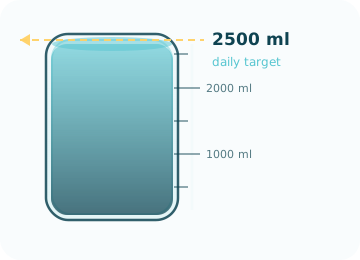
- Target: 2500 ml
- Published: 18 Oct 2026
What a flight actually costs you
Two things happen at altitude. First, cabin air is dry — 10 to 20 percent relative humidity against 40 to 60 in a normal room — and every breath you take out of it is humidified by your own airways. Second, you are sitting still for hours with no access to a kitchen, drinking whatever comes round on a trolley, which is usually 150 to 200 ml twice. The result is that a four-hour flight typically leaves people 700 to 1000 ml down before they have even reached the airport bus.
| Flight length | Fluid lost in the air | Total to drink in the air |
|---|---|---|
| 1–2 hours | 200–400 ml | 400 ml |
| 3–4 hours | 500–800 ml | 800–1000 ml |
| 5–7 hours | 900–1300 ml | 1200–1500 ml |
| 8–12 hours | 1500–2200 ml | 1800–2500 ml |
The empty bottle is the centrepiece
Security rules allow an empty container of any size through in most airports, and every terminal has a water fountain past the checkpoint. Filling a 750 ml bottle at the gate converts an unpredictable trolley service into a known quantity, and it also removes the main reason people under-drink on flights — not wanting to ask, or not wanting to wake a sleeping seatmate. Fill it before boarding; refill it at the destination airport if there is a fountain before baggage claim.
- Empty 750 ml bottle through security
- Fill it at a fountain past the checkpoint, before boarding
- Do not wait for the trolley — it comes twice on most four-hour flights
- Refill at the destination airport before baggage claim
Alcohol, coffee and the pressurised cabin
Airline wine is served at altitude, where the same drink has a stronger effect and a stronger diuretic one. A 150 ml glass of wine on a flight costs roughly 250 ml of fluid once you account for the increased urine output — you lose more than you drank. Coffee is milder: it is a net gain of fluid, but the caffeine keeps some people from sleeping on a flight when sleeping is the most useful thing available. If you want one drink, take it with a 250 ml glass of water alongside.
- 150 ml of wine in the air: about 250 ml of fluid lost overall
- Coffee: still a net gain, but it competes with sleep
- One alcoholic drink maximum per four hours in the air
- Order a 250 ml water with every alcoholic drink and finish it first
Landing, jet lag and the first three hours
The first three hours after landing are when the deficit from the flight either gets cleared or gets carried into the next day as a headache. Drink 500 ml, and 800 ml if the destination is hot. Do not try to fix the whole flight in one go at the arrivals hall — 500 ml in the first hour and the rest over the next two is what the gut will actually absorb. If you crossed more than four time zones, keep drinking to the destination's daytime hours rather than your body's, which helps the body clock as much as it helps the fluid balance.
- 500 ml in the first three hours; 800 ml if the destination is above 30 °C
- Split it: 500 ml in hour one, 300 ml across hours two and three
- More than four time zones crossed: drink on the destination's clock, not your own
- Keep a bottle filled in the hotel room from the first night
Worth keeping
The short version, if you keep nothing else:
- A four-hour flight costs most people 700–1000 ml they do not notice.
- Take an empty 750 ml bottle through security and fill it at the gate.
- Wine at altitude loses you more fluid than it supplies; coffee is a net gain.
- Drink 500 ml in the first three hours after landing, more if the destination is hot.
Clock marks
Every fixed mark for this entry, in order.
| T−2 h (before leaving) | At home, at a normal pace. Not at the airport, where the decision is already behind you. | 500 ml |
| T−1 h (security queue) | Finish the bottle before security so you are not pouring it out at the tray. | 250 ml |
| T−20 min (at the gate) | Fill the empty bottle at a water fountain past security. This is the 750 ml that gets you through the flight. | 750 ml |
| Hour 1 in the air | One third of the bottle. Drink it before the first meal service arrives. | 250 ml |
| Each subsequent hour | 200 ml per hour of flight. A four-hour flight is 800 ml; that is not an accident, it is the arithmetic. | 200 ml |
| Before landing | Finish the bottle 30 minutes before descent so you are not thirsty in the taxi queue. | 200 ml |
| First 3 h after arrival | 500 ml, plus 300 ml extra if the destination is above 30 °C. | 500 ml |
Vessel and weather
What to pour into, and how to change the schedule when it is hot.
-
Vessel
An empty 750 ml bottle taken through security and filled at the gate, plus a 200 ml cup from the cabin service. The bottle is the whole strategy — you cannot rely on cabin rounds.
-
Adjusting for heat
Cabin air sits around 10 to 20 percent humidity regardless of the weather outside, so the plan does not change with season. What changes is the destination: landing somewhere above 30 °C means adding 500 ml in the first three hours after arrival.
- T−2 h — 500 ml at home
- T−1 h — 250 ml before security
- T−20 min — bottle filled at the gate
- Hour 1 — 250 ml
- Each hour after — 200 ml
- Before landing — bottle empty
- First 3 h after — 500 ml