
Midday Heat Plan: 3 Litres for Days Above 30 °C
A 30 °C-plus day needs roughly a litre more than a mild one, and the extra litre has to arrive in the middle of the day rather than at either end. This plan runs from 11:00 to 20:30, puts 1600 ml into the four hottest hours, and treats salt as a food problem rather than a water problem.
- Kind: Day plan
- Part of day: Midday
- Window: 12:00–15:00
- Target: 3000 ml
- Published: 24 Sep 2026
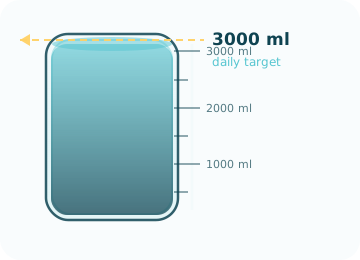
Why the extra litre belongs to the middle of the day
Sweat rate at rest roughly doubles between 22 °C and 32 °C, and the extra loss happens during the hours you are actually hot. Adding 500 ml at breakfast and 500 ml at dinner does not cover it; it just adds night-time urine. The fluid has to be available in the 11:00 to 16:30 window, in small repeated doses, which is why the 14:00 mark is written as 200 ml every 20 minutes rather than 600 ml at once.
| Temperature | Typical resting sweat loss | Suggested daily total |
|---|---|---|
| 18–22 °C | 0.4–0.6 L/day | 1.8–2.2 L |
| 23–27 °C | 0.7–1.0 L/day | 2.2–2.6 L |
| 28–31 °C | 1.1–1.5 L/day | 2.6–3.0 L |
| 32–35 °C | 1.6–2.2 L/day | 3.0–3.6 L |
| Above 35 °C | 2.2 L+ /day | 3.5 L+ and electrolytes |
Small doses, because the stomach empties at a fixed rate
The stomach empties at roughly 10 to 15 ml per minute at rest. That works out to about 800 ml an hour at best, and it drops when the drink is cold, sugary, or drunk in one large volume. Drinking 600 ml in a single go at 14:00 does not get 600 ml into you — it gets maybe 200 ml absorbed over the next hour and 400 ml sitting in the stomach making you feel full. Three 200 ml servings across the same hour is the same volume with none of the sloshing.
- Stomach empties at 10–15 ml per minute at rest
- Practical ceiling: about 800 ml per hour
- 200 ml every 20 minutes beats 600 ml at once
- Very cold drinks slow emptying — keep the bottle cool, not iced
Salt is a food problem, not a water problem
Sweat contains roughly 800 to 1200 mg of sodium per litre. Losing two litres of sweat means parting with 1600 to 2400 mg of sodium, and replacing that from a shaker of water is unpleasant and inexact. It is far easier from food: a normal dinner with a savoury main replaces most of it. Electrolyte tablets or a pinch of salt in the bottle are for the specific case of sweating for more than two hours or wearing heavy clothing in the heat — not for a normal hot day spent mostly indoors.
- Sweat sodium: about 800–1200 mg per litre
- Two litres of sweat = 1600–2400 mg sodium to replace
- A savoury dinner covers most of it
- Electrolytes only for 2+ hours of continuous sweating
- Salt in the water is a last resort, not a habit
The warning signs that mean stop, not drink
Drinking more water is not the answer to every hot-day symptom. Heat exhaustion presents with heavy sweating, cold clammy skin, dizziness and nausea — the response is to stop, get into shade or air conditioning, loosen clothing and sip cool fluid. Heat stroke is different and more serious: hot dry skin, confusion, a temperature above 40 °C. That is a medical emergency and the person should be cooled and taken to hospital rather than handed a bottle of water. Heavy sweating with muscle cramps despite drinking suggests sodium loss, not water loss, and the answer is a salty snack or an electrolyte drink.
- Heat exhaustion: heavy sweating, clammy skin, dizziness — rest, shade, sip cool fluid
- Heat stroke: hot dry skin, confusion, above 40 °C — emergency, call for help
- Cramps despite drinking: sodium loss — salty food, not more plain water
- Never drink more than about 1 litre per hour, even in extreme heat
Worth keeping
The short version, if you keep nothing else:
- Above 30 °C, add roughly one litre and put it in the middle of the day.
- 200 ml every 20 minutes beats 600 ml in one go; the stomach empties at 10–15 ml/min.
- Sweat carries 800–1200 mg sodium per litre — replace it with food, not with salted water.
- Heat stroke is a medical emergency, not a hydration problem.
Clock marks
Every fixed mark for this entry, in order.
| 11:00 | Fill the insulated bottle and finish the first glass before you go out. | 500 ml |
| 12:30 | With lunch. If lunch is a salad with no salt, add salt to the food rather than the water. | 500 ml |
| 14:00 | The peak-heat mark. Drink 200 ml every 20 minutes rather than 600 ml at once. | 600 ml |
| 15:30 | Second half of the bottle. Add an electrolyte tab only if you have been sweating for over two hours. | 500 ml |
| 16:30 | Back indoors. Cool water, not iced — an iced drink after heat load can trigger a headache. | 400 ml |
| 18:30 | With dinner, and this is where the day's salt gets replaced properly. | 300 ml |
| 20:30 | Last glass. On a 3 litre day, keep it at 200 ml or you will be up at night. | 200 ml |
Vessel and weather
What to pour into, and how to change the schedule when it is hot.
-
Vessel
A 1 litre insulated bottle for the 11:00 fill and a 500 ml glass at home for the 16:00 stretch. Insulation matters: a warm bottle gets ignored.
-
Adjusting for heat
This plan only runs above 30 °C. Below that, switch to the desk-day plan at 2000 ml — 3 litres on a 24 °C day is more fluid than most people need and simply means more trips to the toilet.
- 11:00 — 500 ml before going out
- 12:30 — 500 ml with lunch
- 14:00 — 600 ml, in 200 ml steps
- 15:30 — 500 ml second half of bottle
- 16:30 — 400 ml back indoors
- 18:30 — 300 ml with dinner
- 20:30 — 200 ml final glass