
Training Day Plan: When to Drink Around a 90-Minute Session
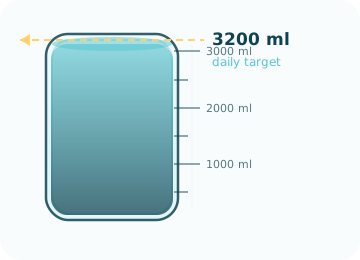
Drinking during a workout is the part everybody remembers and the part that matters least. This plan puts 900 ml in the four hours before the session, 700 ml across it in 20-minute doses, and 1200 ml in the evening — 3200 ml in total, timed so that nothing sits in the stomach when it matters.
- Kind: Day plan
- Part of day: Afternoon
- Window: 15:00–18:00
- Target: 3200 ml
- Published: 6 Oct 2026
The four hours before matter more than the session itself
Starting a session already down half a litre costs you more than any mistake you can make with the bottle in your hand. The 12:00 mark is the important one: 500 ml with lunch, four hours out, at an ordinary pace. Two to four hours before exercise is when fluid moves out of the gut and into the spaces it needs to be in. The 15:30 mark then tops up the last bit and finishes an hour out, so the stomach is empty at the start.
| When | Amount | Pace | Purpose |
|---|---|---|---|
| 4 hours before | 5–7 ml/kg | Normal, with food | Full rehydration, time to distribute |
| 1 hour before | 400–600 ml | Steady | Top up, still time to clear |
| 15 minutes before | 150 ml | Sips | Mouth comfort, no more |
| During | 5–7 ml/kg per hour | Every 20 min | Replace ongoing sweat loss |
| After | 500 ml + salty food | Within 30 min | Replace volume and sodium |
Five to seven millilitres per kilogram per hour
For a 70 kg person, that is 350 to 490 ml per hour — not the litre most people assume. Sweat rates vary enormously between individuals doing the same class: at the same intensity, one person loses 600 ml an hour and the person next to them loses 1400 ml. Weighing yourself before and after a session is the only reliable way to know your own rate. Every kilogram lost is a litre of fluid, and the practical target is to stay within one kilogram of your starting weight.
- 70 kg person: 350–490 ml per hour during the session
- Individual variation: 600–1400 ml per hour at the same intensity
- 1 kg of weight lost = 1 litre of fluid
- Keep the loss under 1 kg; under 2 percent of body weight is the performance line
Sodium is where cramping is decided
Sweat sodium varies even more than sweat rate, from about 400 to 1800 mg per litre. A 90-minute session with heavy sweating can cost 1000 to 2000 mg of sodium, and that is the deficit behind most late-session cramps and the headache that arrives two hours after a long workout. Replacement does not need a sports drink: 500 ml of water plus a salty snack within 30 minutes of finishing does the job. Electrolyte drinks earn their place when the session runs past 60 minutes in the heat or when you are a salty sweater — visible white streaks on dark clothing after training.
- Sweat sodium: roughly 400–1800 mg per litre
- 90 minutes of heavy sweating: 1000–2000 mg sodium out
- Water plus a salty snack within 30 minutes is usually enough
- Electrolyte drink: sessions over 60 minutes in heat, or visible salt streaks
- Cramping late in a session is more often sodium than water
Afterwards: measure, do not guess
The post-session rule is simple arithmetic. Weigh yourself before and after, subtract what you drank during the session, and every kilogram of remaining loss is a litre to replace over the next four hours. Drinking that litre quickly is a mistake — aim for 500 ml in the first 30 minutes and the rest across the evening. Adding 300 ml to the 21:00 mark is fine; adding 1200 ml to it will cost you the night, which is a poor trade for a hydration target.
- Post-session deficit (kg) = fluid to replace (litres)
- 500 ml in the first 30 minutes, the rest across four hours
- Add at most 300 ml to the evening marks
- Training is not a reason to break the 21:00 taper
Worth keeping
The short version, if you keep nothing else:
- 900 ml in the four hours before the session is the part that protects performance.
- During exercise, 5–7 ml per kg per hour — for most people, 350–500 ml per hour.
- Water plus a salty snack replaces sodium unless the session runs long in the heat.
- One kilogram of post-session weight loss equals one litre to replace, spread over four hours.
Clock marks
Every fixed mark for this entry, in order.
| 12:00 (4 h before) | With lunch, at a normal pace. This is the mark that actually protects performance. | 500 ml |
| 15:30 (1 h before) | Finish this 60 minutes out so it has cleared the stomach before you start. | 400 ml |
| 16:15 (15 min before) | Small top-up. Do not drink more than this or you will feel it in the first set. | 150 ml |
| 16:30–18:00 (during) | 150–200 ml every 20 minutes. About 5 to 7 ml per kg of body weight per hour. | 700 ml |
| 18:15 (after) | Within 30 minutes of finishing, with a salty snack if the session was long. | 500 ml |
| 19:30 | With dinner, which is where most of the sodium replacement happens. | 400 ml |
| 21:00 | Final glass. Keep it at 300 ml — training days are not a reason to break the evening taper. | 300 ml |
Vessel and weather
What to pour into, and how to change the schedule when it is hot.
-
Vessel
A 750 ml sports bottle with a wide cap for the session, plus a 500 ml glass at home for the pre- and post-session marks.
-
Adjusting for heat
Indoor gym at 22 °C: use the plan as written. Outdoor session above 28 °C: add 300 ml to the during-session block and take an electrolyte drink rather than water after the 60-minute mark.
- 12:00 — 500 ml with lunch
- 15:30 — 400 ml, finished 60 min out
- 16:15 — 150 ml top-up only
- 16:30–18:00 — 700 ml in 20-minute doses
- 18:15 — 500 ml within 30 minutes
- 19:30 — 400 ml with dinner
- 21:00 — 300 ml final glass