The Two-Sip Rule: Hitching Water to Task Switches Instead of to a Timer
Timers get dismissed. Task switches do not. The two-sip rule attaches roughly 60 ml of water to five things you already do several times a day, which typically lands 500 to 700 ml without a single reminder — and it costs nothing to try this afternoon.
- Kind: Habit anchor
- Part of day: Forenoon
- Window: 09:00–12:00
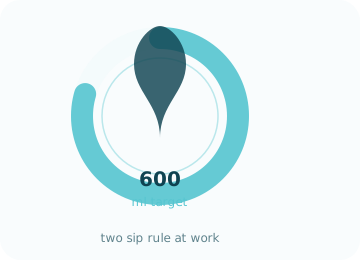
- Target: 600 ml
- Published: 18 Sep 2026
Why habit stacking beats notifications
A phone reminder to drink water competes with every other notification on the same lock screen, and the standard outcome is a dismissed banner. A habit stacked onto an existing action inherits that action's reliability: you already close tickets, you already hang up the phone, you already walk back to your desk. Attaching two sips to something that already happens at a fixed point removes the decision entirely — there is no moment where you have to remember.
| Existing action | Frequency | Water added | Reliability |
|---|---|---|---|
| Closing a task | 6–10 per day | 60 ml | Highest — the action is unambiguous |
| Before a meeting | 3–5 per day | 60 ml | High — meetings are on the calendar |
| After a call | 4–8 per day | 60 ml | High — hanging up is a hard edge |
| Returning to the desk | 5–8 per day | 60 ml | Medium — depends on movement |
| Before replying to a message | Very high | 60 ml | Low — but the volume adds up |
Two sips is deliberately small
Sixty millilitres is a third of a small glass and takes three seconds. That is the point: the habit has to be small enough that you never negotiate with it. A rule of one full glass on every task switch would add four litres a day and would be abandoned by Tuesday. Eight to ten two-sip events across a working day adds 500 to 700 ml on top of whatever you normally drink, which is enough to move most desk workers from a 1.2 litre day to a 1.8 litre day.
- 60 ml per event — three seconds of drinking
- 8–10 events per day: 500–700 ml
- Never upgrade to a full glass on every switch
- If you want more, add events, not volume per event
How to count without an app
Draw five rows on a sticky note — one per working day — and put a single tally mark each time you take the two sips. The pen is the tracking system. After one week you will see which day is weakest; for most people it is the day with back-to-back meetings, where the anchors disappear. The fix is to add an anchor that survives meetings: two sips when the calendar alert fires, before you stand up.
- Sticky note, five rows, one tally per event
- Target: eight marks per day for the first week
- Weakest day is usually the meeting-heavy one
- Add the calendar-alert anchor to cover meeting days
When the habit does not stick
It failed for one of three reasons. Either the anchor is not actually a fixed event in your day ("when I feel like it" is not an anchor), or the container is not in reach (the bottle has to be visible from your chair, not in a bag under the desk), or you tried to do it on every anchor at once. Add one anchor per week. The closing-a-task anchor alone, done for a fortnight, will usually produce more water than all five attempted together for three days.
- The anchor must be an event, not a mood
- The bottle must be visible from where you sit
- Add one anchor per week, not five at once
- Two weeks on one anchor beats three days on five
Worth keeping
The short version, if you keep nothing else:
- Attach 60 ml to five existing task switches; expect 500–700 ml a day.
- Two sips is deliberately small — the habit must never be worth negotiating over.
- A sticky note with tally marks is the entire tracking system.
- Add one anchor per week; the closing-a-task anchor is the strongest.
Clock marks
Every fixed mark for this entry, in order.
| Before each meeting | Two sips at the desk, then walk in. Roughly 3 times a day. | 60 ml |
| After closing a ticket or task | The strongest anchor: a finished task is a clear, repeatable trigger. | 60 ml |
| After each phone call | Hang up, two sips before you type anything. | 60 ml |
| On returning to the desk | Coming back from the printer, the kitchen, the toilet — two sips. | 60 ml |
| Before switching apps to reply | The weakest anchor, but useful on days with no meetings. | 60 ml |
Vessel and weather
What to pour into, and how to change the schedule when it is hot.
-
Vessel
Whatever bottle you already keep on the desk. This habit adds water to the routine you have, so it deliberately does not ask you to buy a new container.
-
Adjusting for heat
The habit is weather-neutral — it stacks onto task switches, not onto temperature. On a hot day the two sips simply get bigger; on a cold day warm water in the bottle keeps the habit alive.
- Mon — tally marks: ____ / 8
- Tue — tally marks: ____ / 8
- Wed — tally marks: ____ / 8
- Thu — tally marks: ____ / 8
- Fri — tally marks: ____ / 8