
Berry and Hibiscus Cold Brew: Eight Hours in the Fridge, One Litre of Deep Red
The only infusion in this set that is made entirely in the fridge. Fifteen grams of whole hibiscus petals and 150 g of frozen berries left for eight hours give a tart, dark red litre that keeps for two days and needs no sugar to be drinkable.
- Kind: Infused water
- Part of day: Afternoon
- Window: 15:00–18:00
- Target: 1000 ml
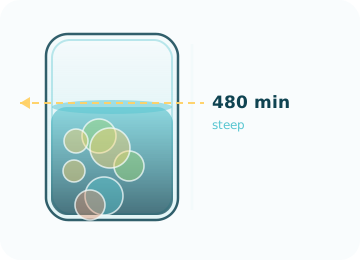
- Steep: 480 min
- Published: 15 Sep 2026
Why eight hours, and why cold
Hibiscus is loaded with anthocyanins, the pigments that make the deep red colour, and those pigments are also what makes the drink taste sour and slightly astringent. Hot water extracts them in five minutes and drags out a heavy, stewed, tannic note at the same time. Cold extraction over eight hours gets the colour and the bright acidity without the stewed character — the same reason cold brew coffee tastes rounder than drip.
| Hours in fridge | Colour | Taste | Verdict |
|---|---|---|---|
| 2 | Pale pink | Mostly water | Too early |
| 4 | Rosy | Berry arrives, sour edge not settled | Drinkable |
| 8 | Deep red | Tart, clean, full berry | The target |
| 12 | Very deep red | Stronger, slightly drying | Dilute 1:1 |
| 24 | Nearly black-red | Astringent, flat | Past its best |
Frozen berries beat fresh ones here
Freezing ruptures the cell walls of the fruit. When the berries thaw in the jar, their juice and pigment leak out into the water within the first hour, which is why this recipe reaches full colour in eight hours rather than the twenty-four a fresh-berry version needs. It is also cheaper and available year-round. There is one caveat: frozen berries often carry surface ice, so weigh them frozen and add the water by volume, not by eye.
- Frozen berries: full colour in 8 hours
- Fresh berries: needs 20–24 hours for the same depth
- Weigh the fruit frozen — the ice glaze is not fruit
- Shake once at hour 3 to move the fruit off the bottom
Acid, enamel and the two-litre ceiling
This is the most acidic drink in the set — hibiscus sits around pH 2.5 to 3.0 once brewed, roughly in lemon juice territory. That is fine in a litre a day taken with food, and it is not fine as an all-day sipper. Cap it at one litre, drink it with or after a meal rather than in a slow drip across six hours, and rinse with plain water afterwards. If you have exposed dentine or reflux, dilute the finished brew 1:1 with water.
- Cap at one litre per day
- Drink with or after food, not sipped continuously
- Rinse with plain water afterwards
- Reflux or sensitive teeth: dilute 1:1
The second-day jar
Sieve the solids out after eight hours and the finished litre holds in the fridge for two days without losing much. Leave the petals in and it keeps for a day before turning astringent. The spent solids are not worth a second brew — almost all the colour and acid is out after one pass — but the berries can go into yoghurt or a smoothie, where their remaining tartness is an asset rather than a problem.
- Sieve at 8 hours, keep the liquid, discard the petals
- Sieveed: 2 days in the fridge
- Unsieved: 1 day, then astringent
- Do not rebrew the solids; use the berries in yoghurt instead
Worth keeping
The short version, if you keep nothing else:
- 15 g whole hibiscus, 150 g frozen berries, 1000 ml cold water, 8 hours in the fridge.
- Cold extraction avoids the stewed, tannic note that hot water pulls out in five minutes.
- Frozen berries reach full colour twice as fast as fresh.
- It is genuinely acidic — one litre a day maximum, always with food.
Vessel and steeping
What to pour into, and the figures that decide the taste.
| Vessel | 1 litre jar with a tight lid, plus a fine sieve. Hibiscus petals are small and a coarse strainer lets the grit through. | |
| Steep | This one is brewed cold in the fridge, so weather does not change the method — only the serving. Hot afternoon: pour over ice. Cold afternoon: drink it at fridge temperature, no ice. | 480 min |
| Yield | 1000 ml |
Recipe card
Ratios for one vessel, so the second one tastes the same.
-
Dried hibiscus petals
15 g (about 4 tablespoons)
Whole petals, not powder. Powder clouds the jar and will not sieve out.
-
Frozen mixed berries
150 g
Frozen works better than fresh here: freezing ruptures cell walls and the colour comes out faster.
-
Cold water
1000 ml
Cold from the tap is fine; the eight hours in the fridge does the work.
-
Orange peel strip (optional)
One 5 cm strip
Adds a bitter orange top note; leave it out if you want the pure berry profile.
-
Honey (optional, at serving)
1 teaspoon per glass
Hibiscus is genuinely sour. One teaspoon takes the edge off without making it a soft drink.
Steep 480 minutes, then strain or lift the fruit out.
This one is brewed cold in the fridge, so weather does not change the method — only the serving. Hot afternoon: pour over ice. Cold afternoon: drink it at fridge temperature, no ice.
- 15 g whole hibiscus petals into the jar
- 150 g frozen berries on top
- Add the orange peel strip (optional)
- Pour 1000 ml cold water, seal
- Refrigerate 8 hours, shake once at hour 3
- Sieve into a second jar, keep the solids out